


2nd item 15% off · 3rd item 20% off
Come Back & Save
2nd order 15% off · 3rd order & beyond 20% off
Savings are shown as one discount across your cart. Offers can't be combined; you'll automatically get the best one. Use the same email each time you check out (or sign in) to unlock returning-customer savings.
Kids Handheld Microscope
Real optics, 50x to 300x
Small enough for a pocket
Works outdoors, not just at a desk
Free shipping on every order
30 day returns on everything we sell
Email and phone support from our team
Secure checkout with encrypted payment
Every parent buying an "educational" gift is making the same bet, and most of them lose it. The science kit gets opened on the day, used once, and is under the bed by the weekend. The wooden puzzle is too young. The tablet game is just a tablet.
And you already know the real competition. It is not other toys — it is the screen. Anything you give a child has to be more interesting than a phone, on its own merits, without you standing over them.
Why most kids' microscopes fail that test
A desk microscope has a setup ritual, and the ritual is the problem. You need prepared slides. You need the specimen flat and thin enough for light to pass through. You need a light source aimed correctly. You need an adult for most of it.
So the sequence goes: child is excited → child has to wait → adult sets it up → child looks at the one prepared slide that came in the box → there is nothing else to look at → done. Twenty minutes, and the novelty is spent because the content ran out.
What changes when the microscope goes to the specimen
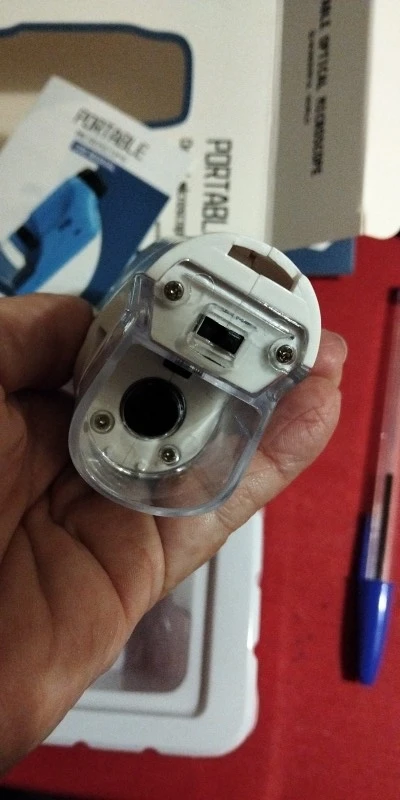
This one is handheld. You press the clear base flat against whatever you want to see and look through the eyepiece. No slides, no mounting, no preparation, no adult.
That single inversion — taking the instrument to the object instead of the object to the instrument — is the whole thing. It means:
- The content never runs out. The world becomes the slide collection. A leaf. A feather. Skin. Salt. Sand. A scab. Carpet. A banknote. A dead bee. The screen on your phone. A child will find things you would never have bought.
- It works outdoors, in a garden, a park, a beach, a walk — where children already are, instead of pinning them to a table.
- The child uses it alone. Press, look, twist the wheel until it is sharp. That is the entire operation.
Why the focus wheel matters more the closer you get
Worth knowing, because it explains the one thing a child needs to learn and why the magnification range is the useful part.
Magnification happens in two stages. The lens at the bottom forms an enlarged image of the object inside the tube, and the eyepiece magnifies that image again. The two multiply together — which is how a tube the size of your hand reaches 300x.
But every optical system has a depth of field: the thin slice of distance that is sharp at once. And here is the rule that governs everything about using one: the more you magnify, the thinner that slice becomes.
At 50x, the in-focus zone is deep enough that a whole leaf surface is sharp at once, including its bumps and veins. Easy to use, and the right place to start.
By 300x, that slice has narrowed to a sliver — so thin that the top of a hair can be crisp while its underside is already blurred. Nothing is wrong when that happens. It is physics, and it is exactly why there is a manual focus wheel instead of a fixed setting: at high magnification you are no longer just focusing, you are choosing which depth to look at, slicing down through the specimen layer by layer.
Once a child works that out, the tool stops being a magnifier and starts being an instrument. It is also why the 50x–300x range genuinely matters: low power to find your subject and frame it, high power to go into it.

It is a real instrument, not a toy that looks like one
At 50x a leaf becomes a landscape of veins. By 300x you are into the cellular structure of plant tissue, the individual barbs and hooks on a feather, the facets of an insect eye. That is a real range — enough that a seven-year-old gets the wow and a twelve-year-old gets something that is still useful for a school project.
What it is honestly not
There is no screen and no camera. You look through the eyepiece. That is a real trade and worth knowing before you buy: it means the image is only for the person holding it, and you cannot photograph it directly.
It is also the reason it is small enough for a pocket, cheap enough to not worry about, and has nothing in it to break, charge or update. For most children, a lens in the hand gets used a hundred times more than a screen device that needs an app and a battery.
Why it works as a gift
It fits the awkward 6 to 12 range where toys are either too babyish or need a screen. It is a safe pick for a child you do not know well, because no one already owns one. And it is one of the very few presents that puts a child outside and looking at something real — which is usually what the person buying it actually wants.
How to use
- Place the clear base flat against whatever you want to look at.
- Look through the eyepiece and turn the focus wheel until the image is sharp.
- Change the magnification on the barrel and focus again for a closer view.
Care and tips
Good light makes the biggest difference — a window or outdoors beats a dim room. Wipe the lens with a soft dry cloth and keep it out of dust and damp. Younger children should be supervised while using it.
Specifications
- Magnification: 50x to 300x
- Type: Optical, viewed through the eyepiece. There is no screen or camera.
- Size: Roughly 20 x 12 x 5 cm
- Weight: About 145 g
What's included
- 1 x handheld microscope
Free shipping on every order
Shipping is free on everything we sell, with no minimum order. You will receive tracking by email as soon as your order is dispatched.
If something is not right, you can return it within 30 days of delivery. Get in touch by email or phone and we will sort it out.


A Microscope That Leaves the House

What Comes in the Box

Point, Twist, Focus
Frequently Asked Questions
Is this a toy or a real microscope?
What age can use it?
What is worth looking at first?
Do I need slides?
How do I look after the lens?
How long does shipping take?
Fast shipping, good quality, yet to test functionality, recommended seller
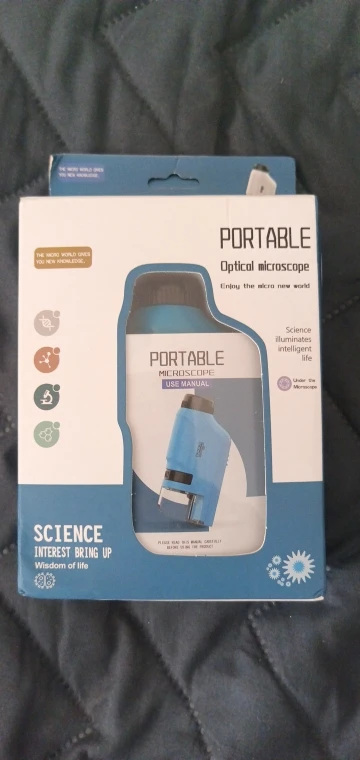
Cool, worth the price, looks excellent
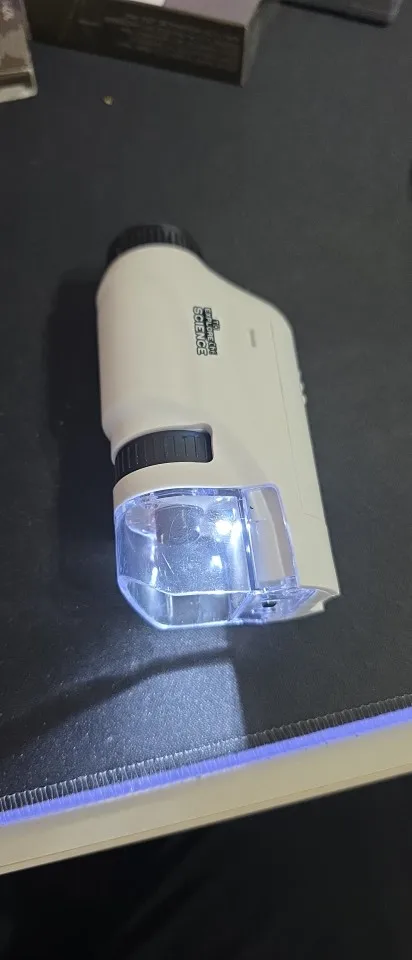
Super cool item. It works with two batteries aaa (not included). I tested it and it works perfectly. I loved it. Perfect for nature.
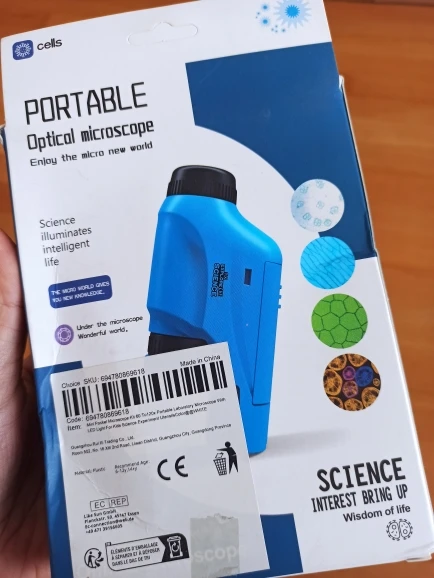
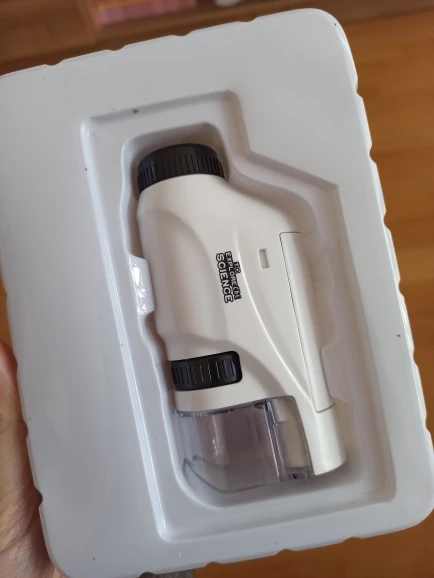
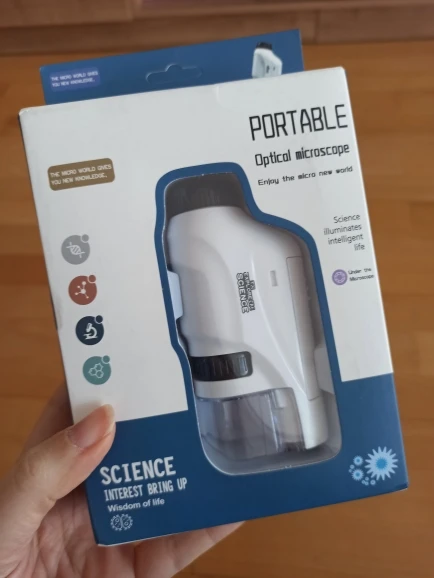
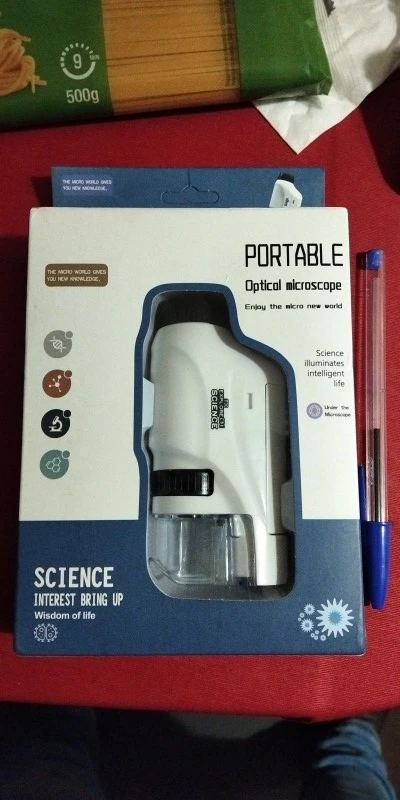
It was in good condition. The box is perfect for giving as a gift. I opened the microscope and put two thin triple A batteries in it. It works and lights up from below. I checked and see that the lens can be adjusted to see things from a different perspective. I am satisfied with the purchase.
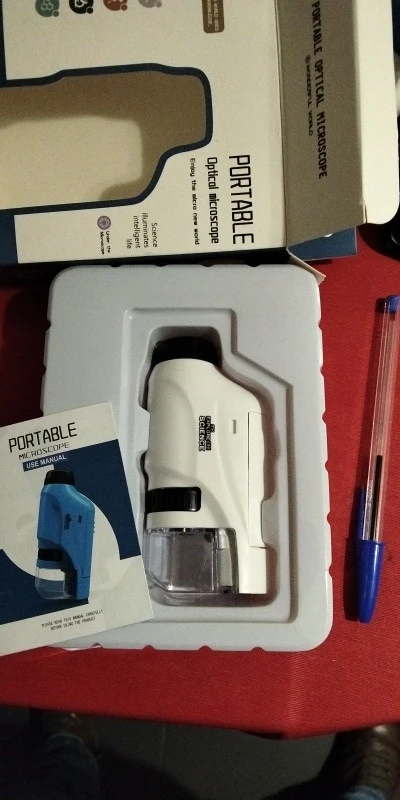
Kids Handheld Microscope
Wow, cool! You can see the pixels on the TV, it arrived really fast and works very well.
I'm amazed by the much better result than I expected. It looks great and the kids love it. I recommend it 100% for kids to have fun with nature and get away from screens.
Kids Handheld Microscope
It's fantastic! It expands a lot and you can see the structures of many things like fabric, leaves, insects... Highly recommended for children. It's not 'professional' but it works well and you can slightly adjust the sharpness. Good purchase!
Requires two batteries, but it's great, my nephew is thrilled.
Kids Handheld Microscope
Kids Handheld Microscope
Kids Handheld Microscope
Kids Handheld Microscope
It’s more of a fun toy for kids. It’s fun.
Kids Handheld Microscope
Works great and at a really cheap price. Thank you and good luck.
ideal for children! perfect size uses 2 3 A batteries
Kids Handheld Microscope
Good product,good seller,would buy again from this store